Removing visible water is only one part of recovery. Water can remain in wall cavities, flooring, and framing after a leak or flood, so Water Damage Edmond checks affected materials and uses managed drying equipment to help bring the space back toward its pre-loss condition.
Water migrates silently along structural pathways—wicking up drywall sheets, collecting within ceiling joists, and swelling subfloors beneath tile and hardwood. Our certified drying specialists map moisture depth using calibrated thermal imaging and non-destructive penetrating probes, engineering a targeted drying vortex tailored to your building's structural footprint.
Successful structural drying is an applied science governed by psychrometrics—the thermodynamic study of moist air. Standard fans and residential dehumidifiers merely displace humid surface air without lowering specific humidity (grains per pound of air). This leaves framing materials saturated and triggers secondary damage like drywall sagging, hardwood buckling, and fungal colonization.
We calculate the exact cubic footage of your affected space, evaporation rates, and moisture load to design a balanced drying system. Using industrial Low-Grain Refrigerant (LGR) dehumidifiers that operate efficiently even below 40 grains per pound (GPP), we pull deep structural moisture out of concrete slabs, joists, and wall studs.
Specialized non-invasive wall cavity injection systems deliver warm, low-vapor-pressure air directly behind baseboards and cabinetry, eliminating moisture pockets without unnecessary wall tear-outs. Every stage is logged with daily psychrometric psychrometer readings until materials meet verified dry standards.
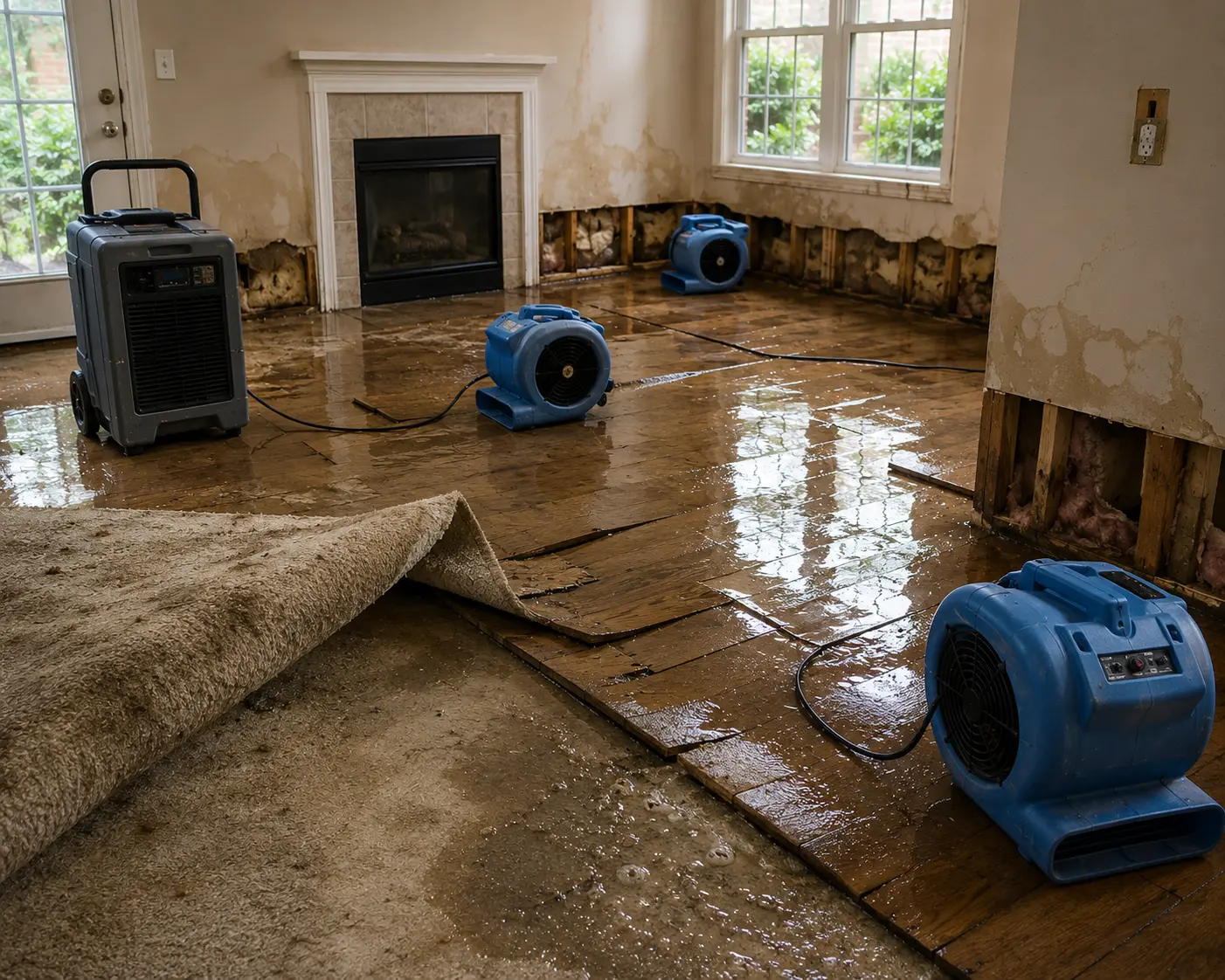
We calculate vapor pressure differentials, specific humidity in grains per pound (GPP), and equilibrium moisture content (EMC) to dry materials faster and protect high-value finishes from warping.
Our commercial fleet of Low-Grain Refrigerant (LGR) and desiccant dehumidifiers operates in extreme humidity and cold temperatures, pulling deep moisture from dense subfloors and masonry.
Rather than tearing out structural walls, we inject pressurized dry air behind baseboards, beneath vanities, and into ceiling bays, preserving intact structural drywall and trim.
We log daily psychrometric readings, thermal imaging records, and moisture meter data to substantiate your claim with private insurance carriers and adjusters.
From initial thermal diagnostic scans to documented dry standard verification, our systematic protocol eliminates bound structural moisture and guarantees safe rebuilding conditions.
We deploy infrared cameras and calibrated pin and pinless moisture meters to detect the full perimeter of hidden water intrusion across walls, ceilings, and subfloors.
Any remaining surface water is extracted with weighted vacuum extractors. Containment chambers and plastic vapor barriers isolate wet zones to accelerate drying efficiency.
High-velocity axial and centrifugal air movers create a laminar vortex along surfaces, breaking the boundary air layer to draw out embedded moisture while cavity injection systems target stud bays.
Commercial LGR dehumidifiers condense airborne water vapor into liquid and pump it safely away, keeping specific humidity low and preventing condensation on unaffected building areas.
We test wood moisture content, ambient RH, and dew points daily. Once all materials reach historical baseline dry standards, we provide written clearance documentation.
We use psychrometric principles and calibrated moisture meters to establish a 'Dry Standard' based on unaffected building materials. We monitor wood Equilibrium Moisture Content (EMC)—typically targeting below 12% to 15% moisture content—along with grains per pound (GPP) and relative humidity, logging daily progress until dry standard clearance is achieved.
Standard household fans simply circulate damp ambient air without dropping specific humidity, and consumer dehumidifiers remove only a few pints of water daily. We utilize industrial Low-Grain Refrigerant (LGR) dehumidifiers capable of pulling 150+ pints per day in sub-40% relative humidity, paired with high-velocity axial air movers creating laminar boundary-layer evaporation.
We employ specialized positive and negative air injection systems. By removing baseboards and drilling unobtrusive micro-openings, we inject warm, super-dry air directly into stud bays or under cabinet toe-kicks, evaporating trapped condensation without requiring costly demolition.
Under standard conditions, structural drying takes between 3 to 5 days. Dense building assemblies like hardwood floors, concrete subfloors, and multi-layer wall assemblies may require additional drying cycles. We monitor daily until readings verify that materials have returned to baseline dry equilibrium.
In most instances, yes, as standard central air conditioning assists in temperature stabilization. However, if water intrusion involves contaminated water or airborne particulate concerns, we seal supply registers and establish dedicated HEPA filtration containment zones to prevent duct contamination.
From older ranch-style homes near Mitch Park and Hafer Park to multi-story executive residences in Oak Tree, Coffee Creek, and Twin Bridges, building materials react differently to water intrusion. Oklahoma's shifting atmospheric conditions—from humid spring storms to cold winter freezes—demand precise psychrometric control. We also serve commercial and residential properties throughout Arcadia, Guthrie, and North Oklahoma City with rapid dispatch and heavy-duty structural drying units.
Do not let hidden structural moisture compromise your property's stability or invite dangerous mold growth. Contact our Edmond drying specialists 24/7 for rapid diagnostic imaging and commercial dehumidification setup.